
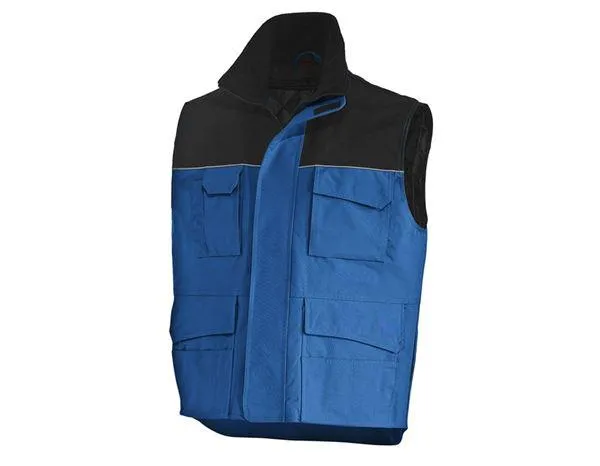
custom logo printed workwear couter body warmer vest
custom logo printed work body-warmer / vest (Turkey & worldwide): prices, typical production/printing techniques, MOQs
Price summary (factory / wholesale ranges)
(prices are FOB/manufacturer-level wholesale estimates; retail will be higher)
- Basic fleece / softshell bodywarmer (Turkey, blank): €6–€18 / piece (depends on weight, lining, softshell vs. fleece). Istanbul Fashion Center
- Quilted / puffer / insulated bodywarmer (Turkey & China factories): €8–€40 / piece — padded/down fill or higher-fill power drives price up; sample/premium down is pricier. MOQ often ≥50–100. Tiger Textile
- Hi-vis / reflective work bodywarmers: €7–€22 / piece (reflective tape and safety fabrics increase cost). Tiger Textile
- Europe / USA branded suppliers (small runs / print-on-demand): expect €20–€50+ / piece for low-quantity bespoke orders (fulfillment, markup, lower MOQ). Tiger Textile
2) Typical logo application costs (per unit, approximate)
- Embroidery (small chest logo): €1.5–€6 per unit (depends on stitch count, colors, logo size). Best for durable, professional look. Tiger Textile
- Screen printing (per color, per print area): €0.8–€4 (cheaper on large runs; extra colors add cost). Good for simple solid-color logos on fabric. Tiger Textile
- Heat transfer / DTF / vinyl (full-color or photographic): €1–€6 per print depending on size/complexity; good for multi-color or small-medium runs. Tiger Textile
- Woven labels / patches / PVC patches: €1.5–€6+ each (patches cost more but give premium look). Tiger Textile
3) Common production constraints — MOQs & lead times
- MOQ ranges:
- Low/POC or POD suppliers: 1–50 (but unit cost high). Tiger Textile
- Factory / OEM production: typical 50–250 min. orders; many workwear producers set ≥250 for customized color/trim. Tiger Textile
- Lead times:
- Samples: 1–2 weeks (plus shipping).
- Small production runs (50–200): 2–4 weeks after sample sign-off.
- Large runs (500+): 3–8 weeks depending on fabric sourcing, trims and peak season.
(Times vary by factory workload and whether customization requires new tooling or embroidery digitizing.) Tiger Textile
4) Which logo/printing technique to choose (by use / design)
- Durable, professional emblem (company chest/breast) → embroidery (durability, tactile). Good for most workwear. Tiger Textile
- Large multi-color back or photographic art → DTF / heat transfer for small runs, screen print for large runs (cheaper per color at scale). Tiger Textile
- Reflective logos / night-work → reflective heat transfer or sew-on reflective tape. Tiger Textile
- Premium badge/branding → woven patch / PVC patch / embroidered badge (adds cost, perceived value). Tiger Textile
5) Example unit-cost scenarios (all approximate, logo applied)
Assume medium-quality 280–320 g fleece or softshell bodywarmer; 1 chest embroidery (8×8 cm); order onshore (Turkey) vs imported (China)
- Small order 50 pcs (Turkey factory)
- Base vest: €9–€16
- Embroidery: €2.5 → Total ≈ €11.5–€18.5 / pc. Tiger Textile
- Medium order 250 pcs (Turkey factory)
- Base vest: €7–€12 (economies of scale)
- Embroidery: €1.7 → Total ≈ €8.7–€13.7 / pc. Tiger Textile
- Large order 1,000 pcs (China/OEM FOB)
- Base puffer/quilting option: €6–€12
- Print/transfer: €0.9–€2 → Total ≈ €6.9–€14 / pc (plus shipping & import VAT). Tiger Textile
6) Practical purchasing checklist — what to include in RFQ (copy/paste to suppliers)
- Item: bodywarmer / vest — style (softshell / fleece / puffer / hi-vis)
- Fabric & GSM (e.g., softshell 3-layer 300 g/m²; fleece 280 g; quilted 120 g lining + 100 g wadding)
- Sizes & colorways and total qty per size
- Logo(s): location (chest/back/sleeve), size in cm, artwork file (vector .eps/.ai/.pdf), preferred application (embroidery / screen / DTF / patch)
- Trims: zippers, pockets, inner lining, branded label, hangtags
- Finish / Certificates: flame retardant? hi-vis EN ISO class? washing instructions?
- Required MOQ, target FOB/FCA price, sample request — ask for lead time and sample cost.
(Using the above gets you apples-to-apples quotes.)
7) Negotiation tips & cost drivers
- Most impact on price: fabric type/weight, insulation/down content, number of trims (zippers/linings), and logo application complexity. Tiger Textile
- Save cost: pick simpler logos (fewer colors), consolidated sizes, standard stock fabric colours, and larger orders.
- Protect quality: request pre-production sample and inspection photos; agree acceptance criteria for seams, stitch counts, and logo placement.
Sources & where those estimates come from
Key manufacturer listings and printing technique pages used to build the ranges and technique guidance: Alibaba product listings and puffer-vest price examples; Turkish workwear & custom clothing manufacturers pages (Tiger Textile etc.); EU POD supplier example (Merchery). These form the basis for the price bands and tech recommendations. Tiger Textile
If you want, I can immediately do one of these next steps (I’ll run the work now — no waiting):
- Create a short RFQ email (Turkish or English) you can send to 5 Turkish manufacturers.
- Build a price table / CSV for the three scenarios above (50 / 250 / 1,000 pcs) so you can compare quotes.
- Find 3–6 Turkish suppliers and request their sample price/lead time (I’ll gather their contact pages and sample MOQ/price).
Which one should I do for you right now?
1) Fabrics for Body-Warmer Vests: Types, Properties, and Use Cases
When choosing the right fabric for a work vest / body warmer, there are trade-offs: warmth, breathability, durability, weight, cost, and how well it works with printing or logos.
Here are common fabrics used + their characteristics:
| Fabric | Structure / Composition | Advantages | Disadvantages / Considerations |
|---|---|---|---|
| Softshell (Polyester + Elastane) | Typically 2- or 3-layer softshell (e.g., outer polyester + elastane, membrane + inner fleece). Example: workwear softshell vests can be 90% polyester, 10% elastane. | Wind-resistant, water-repellent, stretchy, breathable, flexible, good for mobility, professional look. | More expensive than simple fleece; membranes / coatings may limit certain printing (or affect adherence). Also needs proper testing if printing techniques apply. |
| Micro-polar Fleece / Acti-Fleece | High-density knitted polyester fleece; lighter but insulating. Herock uses a 330 g/m² polyester acti-fleece for workwear. Tiger Textile | Very good insulation, soft feel, breathable, comfortable as mid / outer layer, relatively light. | Pile / nap may affect some printing (inks may “sit” differently); fuzziness — pre-treatment or special inks may be needed. |
| Sherpa (synthetic) | Pile on one side, flat on the other; often made of acrylic or polyester. Tiger Textile | Very warm, looks like wool, good for “cozy” vests, aesthetic appeal. | Bulkier / heavier; more challenging for printing because of texture; not ideal for very flat, sharp logos. |
| Polyester Canvas / Ripstop | Polyester or poly-cotton blend with ripstop weave (reinforced grid) used in rugged workwear. Example: 65% polyester / 35% cotton ripstop. Tiger Textile | Very durable, tear-resistant, structured, good for workwear; holds shape well; good surface for embroidery or printing. | Less stretchy / comfortable; heavier; might require more careful handling for heat-based printing; seam details may interfere. |
| Cotton Twill (coated) | 100% cotton twill, possibly water-repellent coated. Herock offers 300 g/m² pre-shrunk cotton twill with water-repellent coating. | Natural feel, breathable, rugged, comfortable, easy to embroider, very good for workwear aesthetics. | Cotton will absorb inks; some techniques (like sublimation) don’t work; coating may affect ink absorption; may shrink if not pre-treated. |
Key fabric-printing interaction points:
- Polyester (especially plain or microfleece) is very good for sublimation, because the dyes bond deeply. Tiger Textile
- For mixed fabrics (cotton + poly), some printing methods (like DTF) are more flexible.
- Tiger Textile
- Softshell (with elastane) may need stretch-friendly inks or techniques to avoid cracking when the fabric flexes.
2) Printing / Logo Techniques: More Detail + Advanced Options
Here are a wide range of techniques (beyond basic screen/embroidery) + how they work, when to use them, and their pros & cons — particularly in the context of body-warmers / vests.
- Screen Printing
- Classic, very common. Uses a mesh (screen) to push ink through a stencil.
- Tiger Textile
- Variants: water-based inks, plastisol, puff, high-density, metallic, flock, etc.
- Tiger Textile
- Best for: large orders, simple designs (few colours), solid logos.
- Pros: very durable, cost-efficient at scale, bold colours. Tiger Textile
- Cons: setup cost (each colour needs a screen), less ideal for gradients or very fine detail.
- Direct-to-Garment (DTG)
- Uses inkjet-style printers to deposit water-based textile inks directly onto fabric. Tiger Textile
- Requires pre-treatment of the garment for better ink bonding. Tiger Textile
- Best for: small-to-medium orders, highly detailed or photographic designs, many colours.
- Pros: high detail, low setup cost, unlimited colours. Tiger Textile
- Cons: less durable than screen printing when heavily washed, works best on certain fabrics (e.g. cotton) Tiger Textile
- Sublimation (Dye-Sublimation)
- Special inks are printed on transfer paper, then heat-pressed so ink turns into gas and bonds with synthetic fibers. Tiger Textile
- Best for: 100% polyester garments, performance wear, all-over designs.
- Pros: very vibrant, permanent (won’t crack/peel), breathable feel. Tiger Textile
- Cons: only works well on light-colour polyester, not good for cotton or dark fabrics. Tiger Textile
- Direct-to-Film (DTF)
- The design is printed on a special PET film (including white ink), powder adhesive is applied, then heat-pressed onto garment. Tiger Textile
- Best for: mixed fabrics (cotton/poly), small to medium runs, designs with lots of detail or gradients.
- Pros: very good durability, high opacity (especially on dark fabrics), no need for pre-treatment like DTG. Tiger Textile
- Cons: slightly “sticker-feel” sometimes, heat-press needed, careful handling required to avoid cracking.
- Embroidery
- Uses threads to stitch the design directly into the fabric. Tiger Textile
- Best for: logos, corporate branding, workwear where a textured, premium finish is desirable.
- Pros: very durable, professional look, great for text/logos. Tiger Textile
- Cons: not ideal for very fine detail or photographic designs; expensive; limited in colour blending.
- Heat Transfer Vinyl (HTV)
- Cut vinyl (or printed vinyl) is heat-pressed onto fabric. Can be plain vinyl, glitter, metallic, etc.
- Best for: names, numbers, simple graphics, accents.
- Pros: relatively low setup cost, very flexible for small runs, durable.
- Cons: layer thickness (feel on the garment), might crack if not applied properly; less breathable in transfer area.
- Sublimation-Transfer (All-Over Print)
- Similar to sublimation, but can cover entire panel of garment (not just small patch).
- Best for: full-panel designs, patterned fabrics.
- Pros: seamless print, very high quality, no “ink feel” – design is part of fabric.
- Cons: limited to compatible fabrics; transfer costs; need precise heat-press control.
- Specialty / Decorative Techniques
- Puff screen printing: creates a raised / 3D puff effect using special inks. Tiger Textile
- Metallic inks: silver, gold screen inks for decorative touches. Tiger Textile
- Flocking: fuzzy velvet-like finish via flock fibers + adhesive. Tiger Textile
- Emboss / deboss: create texture without adding much bulk. (Less common on soft fabrics but possible with special treatments.) Tiger Textile
- Laser / heat-etching: sometimes used in technical fabrics to “burn” or etch a design, though more niche.
3) Choosing the Right Combo: Fabric + Printing Technique
Given fabrics and printing methods, here are some common “good combinations” for a work body-warmer / vest + when to pick what:
- Softshell Vest (poly + elastane)
- Good techniques: DTF, screen printing (with stretch inks), embroidery.
- Why: Softshell offers a smooth outer layer, but because of stretch, the print must tolerate flex. DTF adheres well to poly blends; embroidery adds a premium, resilient logo.
- Micro-Fleece / Acti-Fleece Vest
- Good techniques: embroidery, DTF, puff screen printing (if you want texture).
- Why: Fleece surface is slightly fuzzy — embroidery works well. For prints, DTF can adhere on pile better than very thick screen inks.
- Sherpa / Pile Fabric
- Good techniques: embroidery (for logos), patches (woven or PVC) sewn-on rather than heat-pressed.
- Why: The pile texture makes direct printing less sharp; patch gives clean, high-definition detail, and stitching ensures durability.
- Polyester Canvas / Ripstop Vest
- Good techniques: screen printing, sublimation-transfer (if outer is synthetic), DTF, embroidered patches.
- Why: The structured surface holds print very well; can support more rigid or detailed logos.
- Cotton Twill Vest
- Good techniques: screen printing (water-based or plastisol), embroidery, vinyl heat transfer.
- Why: Cotton takes inks well, and traditional printing works very effectively.
4) Additional Practical Considerations & Trade-Offs
- Durability & Washability: For workwear (which may be washed frequently), durability is key. Embroidery and quality screen printing tend to hold up very well. Some transfer prints (especially poorly applied vinyl or low-quality DTF) may degrade more quickly.
- Feel / Hand: Some techniques add texture. Embroidery is raised. Vinyl feels like a patch. Sublimation feels almost invisible (because dye bonds with fibre).
- Cost vs Volume:
- Screen printing: high upfront (for screens), but very economical for large volumes.
- Tiger Textile
- DTG: little setup, but not as cost-efficient per unit in very large runs. Tiger Textile
- DTF: relatively flexible, good for mid-runs, and works well on many fabrics. Tiger Textile
- Color Fidelity: For photographic, gradient, or very detailed designs, digital methods (DTG, DTF, sublimation) are superior. For flat, bold colours or logos, screen printing is still very strong.
- Breathability / Performance: On technical workwear, you want printing that doesn’t compromise performance. Sublimation is very good, because the print is “in” the fabric and doesn’t block breathability much. Heavy vinyl or thick inks could interfere.
5) Real-World Examples (Products)
Here are a few example vests / bodywarmers where these fabrics + decoration methods are relevant:
- Tiger textile Hooded Vest — typical polyester / fleece-blend vest; good candidate for embroidery or DTF.
- Reversible Fleece Vest Tiger textile — fleece fabric; ideal for embroidery, DTF, or puff print for a textured design.
- Tiger textile Puffer Vest — puffer style (insulated); you could use a patch, embroidery, or heat transfer for the logo.