
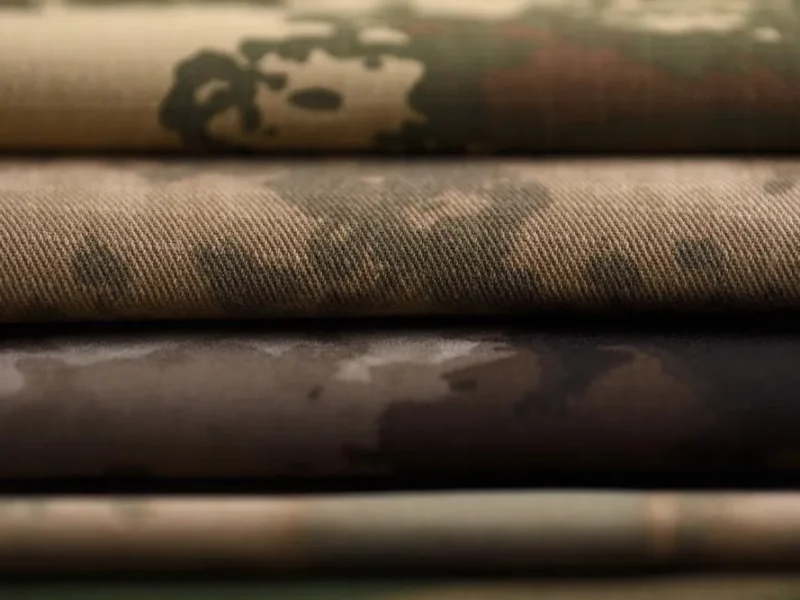
military fabrics for camouflage
technical overview of military fabrics from material basics to production techniques and printing especially camouflage patterning
What Military Fabric Means
Military textiles are engineered to meet strict performance standards that go far beyond ordinary apparel fabrics. These include durability, protective functions, comfort, and often camouflage/stealth requirements. Tiger Texile
Technical Traits
- High Mechanical Strength: Tensile and tear resistance are much higher than civilian fabrics, achieved by strong yarns and tight weaves such as twill, duck, ripstop, or canvas structures.
- Abrasion & Wear Resistance: Maintains integrity under rough use (rucksacks, uniform stress).
- Environmental Resistance: Treated or engineered to resist water, UV, flame, chemicals, microbial growth, and sometimes extreme temperatures.
- Low IR/NIR Reflectivity: Minimizes detection under infrared surveillance systems
- Breathability & Moisture Handling: Keeps wearer comfortable; reduces heat stress.
- Dimensional Stability: Limited shrinkage after laundering (often <1–3% in mil specs).
Typical Fiber Types
- Cotton blends (Cotton–Polyester, Cotton–Nylon or NYCO) for uniforms — good comfort + durability.
- Polyamide (Nylon) and Cordura® for gear and packs — high tensile strength and abrasion resistance.
- Aramids (Kevlar®, Nomex) for protective gear (ballistic or flame resistance). Standards and Specifications
- MIL-SPEC / Defense Standards: Documents like MIL-DTL-32143, MIL-DTL-44436B provide precise fiber blends, weight (gsm), weave, colorfastness, and performance tests required for military procurement.
- NATO STANAG & National Defense Specs: Standards harmonize testing and performance across allied forces.
Production Techniques
Fiber → Yarn
Military fabrics start at the fiber level:
- High-tenacity fibers (e.g., Nylon 6.6) are spun into yarns with strong tensile properties.
- Yarn treatments (antistatic, UV stabilization, flame retardant) can be incorporated at this stage.
Weaving / Knit Structure
Most military fabrics are woven rather than knit (knit is used in inner layers or moisture-management pieces).
Common Weaves
- Ripstop: Reinforced with thicker threads at intervals to prevent rips from propagating. Excellent for uniforms and gear.
- Twill: Diagonal pattern for strength and flexibility.
- Canvas / Duck: Dense plain weaves for high-stress uses.
The weave density (ends/inch & picks/inch) and yarn denier (thickness) are selected based on balance of durability, comfort, and weight.
Fabric Finishing & Treatments
After weaving:
- Water-repellent & stain-resistant finishes (DWR/Teflon)
- Flame-resistant coatings or inherent FR fibers
- Antimicrobial treatments
- Infrared-suppressive finishes
These finishes help uniform and gear perform in field conditions.
Printing Techniques for Patterns for Especially Camouflage
Printing in military textiles usually refers to camouflage pattern application and often other functional prints
Primary Printing Methods
- Roller Screen Printing
- Fabric runs under rotating engraved rollers that deposit dyes in camouflage patterns.
- High-speed and consistent — widely used for large runs like woodland or desert camo.
- Flat Screen Printing
- Traditional screens place each color separately.
- Good for shorter runs or specific pattern requirements.
- Digital Textile Printing
- Newer method where true digital files are used to “jet” dyes onto fabric.
- Allows detailed, multi-color, and environment-specific patterns with less setup time.
Key Goals of Camouflage Printing
- Color fastness: Resist fading under sun/moisture.
- Penetration: Dyes are bonded deeply (often vat dyes) for durability and skin safety.
- Pattern precision: Pixelated or fractal designs (like MARPAT or MultiCam) improve concealment.
Technical Testing & Quality Control
Before and after production, military fabrics are tested for:
- Tensile / tear strength
- Colorfastness to light, laundering, and abrasion
- Water repellency
- Flame resistance
- Infrared reflectivity
- Dimensional stability
These tests ensure compliance with mil-spec standards and reliability in the field.
Examples of Specific Military Fabrics & Patterns
- NYCO (Nylon–Cotton) blends – Common for combat uniforms (balance of strength & comfort).
- Ripstop cotton/poly blends – Durable, often base cloth for printed camo.
- MultiCam, MARPAT, Flecktarn – Standard camouflage patterns printed on technical fabrics for concealment in specific environments.
| Aspect | Military Fabric Requirements |
|---|---|
| Materials | High-strength fibers, blends (Cotton, Nylon, Polyester, Aramids) |
| Structure | Ripstop, twill, duck — tailored for durability |
| Finishes | Water repellent, flame resistant, antimicrobial, IR low |
| Printing | Roller, flat screen, digital; deep dye penetration & pattern fidelity |
| Standards | MIL-SPEC, NATO, ISO testing for performance |
MILITARY FABRICS
Technical Production & Printing
REAL MIL-SPEC TECHNICAL DETAILS
Common Military Uniform Fabric: NYCO Ripstop
(Nylon / Cotton Blend)
Typical Specification (Example: MIL-DTL-44436 / MIL-DTL-32143)
| Parameter | Typical Requirement |
|---|---|
| Fiber Content | 50% Nylon 6.6 / 50% Cotton |
| Fabric Weight | 210–230 g/m² (6.0–6.8 oz/yd²) |
| Weave | Ripstop (reinforcement grid every 5–8 mm) |
| Yarn Count | Warp: 40–70 denier nylon / Weft: cotton |
| Tensile Strength | Warp ≥ 700 N / Weft ≥ 600 N |
| Tear Strength | ≥ 15–20 N |
| Shrinkage | ≤ 3% (warp & weft) |
| Colorfastness (Wash) | ≥ Grade 4 |
| Colorfastness (Light) | ≥ Grade 4–5 |
| IR Reflectance | Controlled (NIR compliant) |
| Finish | DWR + IR suppression |
Why NYCO?
- Nylon → strength & abrasion resistance
- Cotton → comfort & breathability
- Ripstop → prevents tear propagation
Flame-Resistant Military Fabric
Example: MIL-DTL-32143 (FR Combat Uniform)
- Fiber: Aramid / FR Rayon / Nylon blend
- Does NOT melt or drip
- After-flame time: ≤ 2 seconds
- Char length: ≤ 100 mm
- Used for:
- Combat uniforms
- Flight suits
- Vehicle crew garments
MILITARY FABRIC PRODUCTION PROCESS (STEP-BY-STEP)
1: Fiber Selection
- Cotton (long-staple, combed)
- Nylon 6.6 (high-tenacity)
- Optional: Aramid, Polyester FR
2: Yarn Spinning
- Ring spinning (cotton)
- Filament extrusion (nylon)
- Controlled twist for strength & flexibility
- Antistatic or UV additives may be added
3: Weaving
Most used looms:
- Air-jet or rapier looms
Common structures:
- Ripstop → uniforms
- Twill → jackets & trousers
- Plain / Duck → gear & packs
4: Fabric Pretreatment
- Desizing
- Scouring
- Bleaching (controlled whiteness)
- Heat setting (dimensional stability)
5: Dyeing / Printing (see Section 3)
6: Finishing
- DWR (Durable Water Repellent)
- Oil & stain resistance
- IR suppression coating
- Antimicrobial finish
- FR chemical finish (if not inherent)
7: Testing & Certification
- Tensile / tear tests
- Wash & light fastness
- Infrared reflectance
- Shrinkage
- Flame resistance (if required)
CAMOUFLAGE PRINTING TECHNIQUES
- ROTARY SCREEN PRINTING (MOST COMMON)
Used for:
- Woodland
- Desert
- Flecktarn
- MultiCam-style patterns
Process:
- One engraved roller per color
- 4–8 colors typical
- Continuous production
- High penetration dyes
Advantages:
✔ Extremely durable
✔ Color consistency
✔ High production speed
Disadvantages:
High setup cost
Not ideal for small orders
- FLAT SCREEN PRINTING
Used for:
- Short runs
- Special forces / custom patterns
High color density
Slower than rotary
- DIGITAL CAMOUFLAGE PRINTING (ADVANCED)
Used for:
- Pixelated camo (MARPAT, CADPAT)
- Rapid prototyping
- Environment-specific patterns
Technology:
- Reactive or disperse inks
- Inkjet heads
- Computer-generated pattern files
Unlimited colors
Fast design changes
Higher cost per meter
IR control more complex
INFRARED (IR / NIR) CAMOUFLAGE CONTROL
Critical military requirement
Military fabrics must reflect IR light similar to natural surroundings.
How it’s achieved:
- Special pigments in dyes
- IR-absorbing additives
- Lab testing under NIR cameras
Without IR control → uniform visible to night-vision devices
COMMON MILITARY CAMOUFLAGE FABRICS
| Fabric Type | Typical Use |
|---|---|
| NYCO Ripstop | Combat uniforms |
| Cotton Ripstop | Hot climate uniforms |
| Polyamide Canvas | Backpacks, vests |
| Aramid | Fire & flight gear |
| Softshell Laminates | Tactical jackets |
WHERE THIS IS USED (PROCUREMENT VIEW)
- National armies
- NATO suppliers
- Police & gendarmerie
- Private military contractors
- Tactical clothing brands
✔ Military fabrics are engineered systems, not just textiles
✔ Fabric + dye + finish + IR control = one integrated solution
✔ Printing is as critical as weaving
TURKEY – Local & Market Prices
Tactical & Military Fabric (Retail / Small Quantity)
These are mostly civilian-accessible fabrics that are similar to military types (uniform/camo batches):
- Camouflage fabric (standard poly-cotton ripstop / twill for uniforms):
- Approx €5–€10 per meter (~ $5–$11) on some European surplus sites, though specific Turkish market prices vary.
- On Turkish B2B uniform fabric supplier listings, fabrics like:
- NYCO (nylon-cotton) ripstop
- TC 65/35 polyester-cotton twill
- FR camo blends (e.g., 66% viscose FR + aramid)
— are offered but prices aren’t listed publicly — you must request a quote.
In Turkey you’ll often find camouflage fabrics sold at fabric
WORLD / GLOBAL MARKET – Wholesale & B2B Prices
Camouflage & Tactical Fabrics (Poly-Cotton, Ripstop)
Typical global wholesale ranges per meter:
| Fabric Type | Typical Price (USD/m) | Notes |
|---|---|---|
| Poly-Cotton Camouflage Ripstop (TC 65/35) | $1.30 – $3.80 | Standard combat/BDU fabrics in bulk |
| Uniform Multicam-style Ripstop (TC 50/50) | $1.45 – $3.80 | Higher quality prints or patterns |
| Nylon-Cotton Ripstop (NYCO) | $1.90 – $3.99+ | Depends on GSM & finish |
| Budget Tactical Camo Polyester/Cotton | $0.89 – $2.40 | Lowest-cost bulk options |
Note on bulk pricing:
- Orders of thousands of meters significantly reduce unit cost (., ~$1.30–$1.80/m for large orders).
SPECIALTY & HIGH-END MILITARY FABRICS
These have much higher unit costs because of performance:
High-Performance Nylon (Cordura® & Ballistic)
Military-grade nylon fabrics typically used for gear, packs, plates, heavy load-bearing equipment:
500d/1000d Cordura Tactical Fabric
₺51.295,80
- Made-in-turkey
1000d Ballistic Nylon Cordura Camo Fabric
₺64.119,74
- Made-in-turkey
Cordura 1000 Nylon Fabric
₺1.226,64
- Basik Air Concept
70D Ripstop Nylon Waterproof Fabric
₺382,58
- Emmakites + diğer satıcılar
- 500d/1000d Cordura Tactical Fabric — heavy duty polyester/nylon mix for packs/gear (, tactical vests, rucksacks) — high-strength industrial textile (~ tens of thousands of TL per roll in Turkey).
- 1000d Ballistic Nylon Cordura Camo Fabric — premium ballistic/gear-grade, often used in military kit — highest-tier pricing.
- Cordura 1000 Nylon Fabric — commonly used in tactical bags & equipment — mid-range among military textiles.
- 70D Ripstop Nylon Waterproof Fabric — lighter nylon for uniform shell layers or pack liners.
Typical pricing for these specialty fabrics (in retail form, per yard, not bulk):
- 500d nylon Cordura: $8–$25+ per yard (~ $8–$25) depending on finish, waterproof coating, camo, and source.
- X-Pac and aramid-reinforced fabrics: $40–$50+ per yard on specialty sites.
(1 yard ≈ 0.91 meter; retail prices are much higher than large-lot OEM pricing.)
SUMMARY – APPROX MILITARY FABRIC PRICE RANGES
| Use Case | Typical Price Range | Notes |
|---|---|---|
| Uniform Camo ripstop (global bulk) | $1.30 – $3.80 / m | Poly-cotton or NYCO blends |
| Budget printed camo (low end) | $0.89 – $2.40 / m | Commodity camo fabrics |
| Premium ripstop (NIR/IR, high-grade) | $3.80+ / m | Better durability & certification |
| Heavy tactical gear nylon (500–1000d) | ~$8 – $25/yd (~$9–$28/m) | Specialty gear fabrics |
| Ultra-premium ballistic-grade textiles | $40+/yd (~$44+/m) | Laminated/aramid reinforcement |
| Turkish local market camo fabric | ~€5–€10 / m | Retail style surplus pricing |