
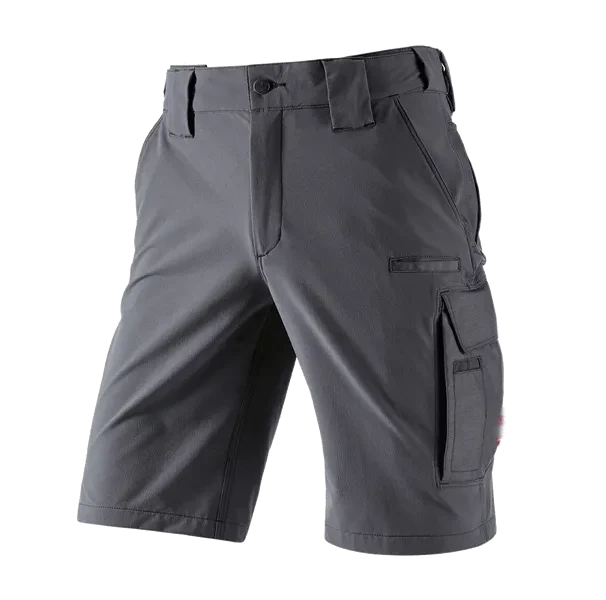
functional work shorts custom logo printed
custom-logo functional work shorts , recommended fabrics, detailed printing/decoration techniques (what works best where), MOQs,
- Turkey factory (small/medium runs): €6 — €18 / pair
- istanbul (large OEM runs): US$3 — $9 / pair
- turkiye/ istanbul: US$3.5 — $9 / pair
- TR/EU / small bespoke runs: €12 — €30+ / pair
1) Common fabrics for functional work shorts — properties & when to use them
(Include exact composition & GSM in RFQ.)
- Cotton Twill / Chino Twill (220–280 g/m²)
- Classic feel, good for embroidery and screen-print, breathable. Best for general-use work shorts.
- Poly-Cotton Twill (65/35 or 60/40, 200–260 g/m²)
- Lower cost, less shrink, good industrial wash properties — popular for uniforms.
- Ripstop Polyester / Poly-Cotton Ripstop (180–260 g/m²)
- Lightweight, tear-resistant — great for utility shorts needing abrasion resistance and quick drying.
- Quick-Dry Polyester / Microfiber (130–180 g/m²)
- Excellent for performance / outdoor work shorts — perfect for sublimation/all-over prints and fast drying.
- Canvas / Heavy Duck (8–12 oz / 280–380 g/m²)
- Heavy duty, reinforcement friendly — choose for trades where abrasion and tool pockets are essential.
- Cordura / nylon reinforcements (patches at pockets/knees)
- Use on high-wear points; adds cost but greatly improves longevity.
- Stretch blends (Cotton + 2–4% Elastane)
- Adds comfort & mobility — good for fitted functional shorts.
2) Printing & decoration techniques — which to use for shorts (detailed)
- Embroidery
- Best uses: small chest/logo on waistband, pocket flap, back pocket badge.
- Pros: extremely durable, professional look, survives frequent washing.
- Cons: can be costly if large/dense; not ideal on very thin quick-dry fabrics without backing.
- Typical cost per logo (factory level): €0.8 – €4 / unit (small → large).
- Screen Printing (Plastisol / Water-based)
- Best uses: flat single-colour designs, large back thigh prints, inner waistband prints.
- Pros: very economical at scale, durable (plastisol), soft hand (water-based).
- Cons: setup per colour; heavy inks can stiffen thin fabrics.
- Cost per print: US$0.25 – $1.50 / unit (1 colour, scale dependent).
- DTF (Direct-to-Film) & Heat Transfer
- Best uses: full-colour logos, small/medium multi-colour graphics on cotton & blends.
- Pros: no colour limits, good opacity on darker fabrics, flexible application at medium runs.
- Cons: slight transfer hand; quality depends on film/adhesive.
- Cost: US$0.8 – $3 / unit.
- DTG (Direct-to-Garment)
- Best uses: photographic detail on flat cotton panels (less common on shorts because seams/pockets).
- Pros: high detail, low set-up.
- Cons: pre-treatment for non-cotton, not ideal over seams.
- Cost: US$1.5 – $4 / unit.
- Sublimation / Dye-Sublimation
- Best uses: 100% polyester quick-dry shorts and all-over patterns; prints are “in” the fabric.
- Pros: no hand, very breathable, permanent colour.
- Cons: only for white/light polyester or pre-treated base colours; fluorescent/very dark garments limited.
- Cost: US$0.4 – $1.5 / unit (panel/area dependent).
- Reflective Heat Transfers / Reflective Inks
- Best uses: safety accents, reflective logos or piping.
- Pros: adds night visibility.
- Cons: reflective materials add cost; verify wash durability.
- Cost: US$1 – $4 / unit.
- Silicone / Rubber / PVC Transfers
- Best uses: tactile logos, numbers, areas that need rubberized feel (tool brand, sporty look).
- Pros: durable, premium feel.
- Cons: higher unit cost; may add stiffness.
- Cost: US$1.5 – $5 / unit.
- Sewn Patches / Woven Labels / Leather Tabs
- Best uses: branded back tab, pocket label, sewn detailing.
- Pros: premium, durable.
- Cost: €0.5 – €4+ / unit (label + sew cost).
3) Which technique for which fabric — quick combos
- Cotton twill / poly-cotton → Embroidery (logos), screen print (large flat graphics), DTF (multi-colour).
- Ripstop / canvas → Embroidery or sewn patch (texture can make prints look uneven), durable screen print OK on flatter panels.
- Quick-dry polyester → Sublimation (best), DTF (if mixed fabrics), reflective transfers for safety accents.
- Stretch blends → DTF with stretch film, stretch-friendly screen inks, or small embroidery with soft backing.
4) MOQs, lead times, common production constraints
- MOQ ranges: Turkey: 50–200; turkey: 100–500 typical; Bangladesh/Vietnam: 200+ for custom colors/trim.
- Sample lead time: 7–14 days (+ shipping).
- Production lead time: 2–6 weeks after PP approval for typical runs; longer for large orders, custom trims or fabric backorders.
- Tools / setup: screen printing needs screens per colour; embroidery needs digitising (one-time fee); sublimation needs printed panels, so pattern placement matters.
5) Per-logo / decoration cost bands (factory level, ballpark)
- Small embroidery (2–5 cm): €0.8 – €2
- Medium embroidery (6–10 cm): €1.8 – €4
- Screen print (1 colour, small): US$0.25 – $0.8
- Screen print (multi-colour / large): US$0.8 – $2+
- DTF / Heat transfer: US$0.8 – $3
- Sublimation (panel-based): US$0.4 – $1.5
- Reflective transfer / reflective ink: US$1 – $4
- Silicone/PVC transfer: US$1.5 – $5
6) Example all-in unit cost scenarios (illustrative)
- Turkey — 100 pcs, cotton twill 240 g, 2 side cargo pockets, small embroidered logo
- Short base price: €7–€12
- Embroidery: €1.5 → Total ≈ €8.5–€13.5 / pair
- Turkey — 500 pcs, poly-cotton ripstop short, reinforced Cordura pocket, 1-colour screen print
- Short base price: US$3.5–$6
- Screen print: $0.4 → Total ≈ US$3.9–$6.4 / pair
- istanbul — 1,000 pcs, quick-dry polyester performance short, sublimation full-panel print (all-over pattern)
- Short base price: US$3.8–$7
- Sublimation / pattern cost: $0.6–$1.5 → Total ≈ US$4.4–$8.5 / pair
- Small EU run — 50 pcs, premium canvas short with leather brand tab + embroidered logo
- Short base price: €14–€28
- Leather tab + embroidery: €3–€8 → Total ≈ €17–€36 / pair
7) RFQ checklist — copy/paste to suppliers
Include the following to get comparable quotes:
- Product name: functional work short — attach tech sketch (front/back, pocket placement).
- Fabric: composition (%) + GSM + swatch code (e.g., 65%/35% poly-cotton twill 240 g).
- Reinforcements: Cordura at pocket, bartacks, rivets, knee-pad pockets?
- Pockets: qty, sizes (cargo, tool pocket, phone pocket), zipper/Velcro details.
- Trims: YKK zipper? metal/plastic snaps? drawcord? belt loops?
- Sizes: full size breakdown and qty per size.
- Colour: Pantone or exact factory colour code.
- Logo(s): position (waistband, pocket flap, back), size in cm, artwork (vector .ai/.eps), preferred method(s) — ask supplier to quote per-method (embroidery / screen / DTF / sublimation).
- Certification/finish: pre-shrink? wash/stonewash? water-repellent DWR finish? FR treatment?
- Packing: pcs per poly bag, cartons, tags, hangtags, labels.
- MOQ: sample price, sample lead time, bulk prices for 50 / 100 / 250 / 500 / 1000.
- Lead time: sample lead time, production lead time after PP approval.
- Quality: request PP sample, stitch counts/photos, and option for third-party inspection.
- Payment & shipping terms: EXW/FOB, payment terms (TT/LC).
8) Quick supplier negotiation levers & QC tips
- Consolidate colours to factory stock colours to avoid dye surcharge.
- Ask for per-logo quotes for multiple methods — often embroidery is cheaper after a certain qty.
- Request photos of previous similar items (show stitch density for embroidery; transfer finish photos).
- For DTF/heat transfers make them provide wash test evidence (5–20 wash cycles).
- For sublimation ask for fabric % and pre-treatment details (only 100% polyester or specially treated blends give best results).
——————————————————————————————————————————
Fabric options, printing technique details, and real cost-drivers for custom-logo functional work shorts for Functional Work Shorts
| Fabric Option | Key Characteristics | Pros for Work Shorts | Cons / Challenges |
|---|---|---|---|
| Cotton Ripstop | Cotton woven in ripstop grid | Tear-resistant but still breathable, classic look | Heavier than plain cotton; slightly higher cost |
| Poly-Cotton Ripstop (e.g. 65/35) | Ripstop weave + blend | Strong, abrasion-resistant, less shrinkage, good for utility gear | Less “natural” feel; print adhesion can differ vs 100% cotton |
| Quick-Dry / Performance Polyester | Lightweight synthetic | Very fast drying, great for hot / outdoor work, can be extremely durable | Not as great for some printing techniques (DTG less effective) |
| Nylon / Cordura-Reinforced Panels | Nylon fabrics, or cotton with Cordura patches | Ultra-durable in high-wear zones like pockets or hems, great for tactical / tool shorts | More expensive; sewing is more complex; print-ability on nylon is harder |
| Stretch Cotton (Cotton + Elastane) | Cotton blend with ~2–4% elastane | More flexible and comfortable, better movement | Embroidery / thick prints may not work well in highly elastic areas unless optimized |
| Gabardine / Twill Weave Cotton | Twill weave cotton, often 220–300 g/m² | Durable, good drape, classic workwear aesthetic | Less breathable than lighter cotton, somewhat stiffer |
For reference, Uniprom (Turkish workwear) makes a 100% cotton gabardine work pant at 245 g/m². tigertextile.com.tr
They also have a high-gsm 100% cotton “kışlık (winter)” work pant in gabardine at 390 g. tigertextile.com.tr
And for a mixed fabric, Formteks lists a %65 cotton / %35 polyester blend for work fabrics in its catalogue. tigertextile.com.tr
More Printing / Decoration Technique Details (Advanced)
Here are deeper details on printing techniques, plus cost-drivers, technical constraints, and trade-offs specifically for functional work shorts:
- Screen Printing (Plastisol / Water-Based)
- How it works: Ink is pushed through a mesh screen stenciling your design. For plastisol, the ink sits on top of fabric; for water-based, it penetrates more.
- Best for: bold logos, single- or few-colour graphics on cotton or poly-cotton short panels, pocket areas, leg graphics.
- Cost drivers: number of colours (each needs a screen), print size, mesh count, ink type, run volume.
- Challenges: large prints on stretch or very textured fabrics require special inks or mesh; thick plastisol can stiffen fabric.
- Unit cost: for large runs, screen printing can be very economical.
- DTG (Direct-to-Garment)
- How it works: Inkjet-style printer sprays ink directly onto the garment. Requires pre-treatment for certain fabrics to make the ink bond well. tigertextile.com.tr
- Best for: very detailed or photographic prints on cotton (or high-cotton blend) fabric.
- Cost drivers: pretreatment, amount of ink (coverage area), maintenance, and cure/dryer time.
- Limitations on shorts: seam lines, pockets, and curved areas make DTG less ideal for some parts; must place design on flat, accessible areas.
- Typical usage: short runs, prototyping, custom or low-volume orders.
- DTF (Direct-to-Film)
- How it works: The design is printed on a PET film, adhesive powder is applied, and then it’s heat-pressed to the garment. This is very flexible tigertextile.com.tr
- Best for: multi-colour or gradient designs, small-to-medium runs, mixed-materials (cotton + poly).
- Cost drivers: film cost, adhesive powder, curing / pressing parameters.
- Trade-offs: slightly rubbery feel depending on film; good wash durability if done correctly.
- Advantages: relatively low setup; no need for large screen separation; works well on many fabrics.
- Sublimation (Dye-Sublimation)
- How it works: Special inks on transfer paper turn into gas under heat and bond with synthetic fibers. Promotional Merchandise
- Best for: 100% polyester or poly-coated shorts, especially for full-panel or all-over prints, performance / technical designs.
- Cost drivers: ink use, paper cost, heat press or calendar speed, fabric type (must take dye).
- Limitations: doesn’t work well on cotton; need light base colour (white or very light) for textile to absorb print.
- Durability / Feel: very good; print is “inside” the fiber so no heavy hand.
- Other Methods: Hybrid Digital Textile Printing
- For very large fabric panels, industrial digital textile printers (for cotton, linen, polyester) exist. For example, HPRT makes conveyor-belt printers for cotton / linen / polyester. tigertextile.com.tr
- Useful for pre-printing fabric before cutting (if you’re producing your own patterns).
- Cost: setup cost is high, but per-meter print cost can be relatively low at volume.
Cost-Drivers & Trade-Offs Should be Focused On
- Fabric weight (GSM): heavier fabric costs more, and printing on heavy fabric may require more ink or special treatment.
- Print placement: whether it’s on pocket, thigh, waistband — some locations are easier to print than others.
- Print size and colour count: more colours and bigger print = more cost.
- Run length: digital (DTG, DTF) shines for small/custom runs; screen is cheaper per unit on large runs.
- Pretreatment / curing: especially for DTG and DTF, this adds cost/time.
- Durability needs: want prints to survive many washes → may need higher quality inks, which cost more.
- Fabric stretch or texture: fabrics with elastane or ripstop or heavy canvas may need different inks or techniques.
- Machine availability / supplier capability: not all factories have DTG or DTF, and those that do may charge more.
OEM so you can see what people are already buying, to guide spec / quality decisions:
- istanbul Cargo / Utility Shorts — performance-style, multiple pockets, likely synthetic or blended fabric for water resistance; good for performance workwear
- istanbul″ Essential Cargo Short — cotton blend car-go short, fashion-workwear crossover
- 13-Inch Multi-Pocket Utility Short — extra functional pockets, good design reference for work / tactical style
- Specify fabrics in detail: In your RFQ, mention not only % cotton/poly, but also the GSM, weave (ripstop / twill), and any reinforcement panels.
- Ask for multiple print-method quotes: Request unit prices for embroidery, DTF, screen, and sublimation (if polyester) so you can compare.
- Require wash test: Ask for transfer / print durability after, say, 10 washes — especially for DTF or dye-based methods.
- Get pre-production sample: For custom work shorts, ask for sample with the actual fabric + print + pocket design + hardware to validate quality.
- Negotiate fabric & print separately: Often, the margin is hidden in fabric cost; if you break out fabric + print + cut/sew, you can press suppliers on each piece.