
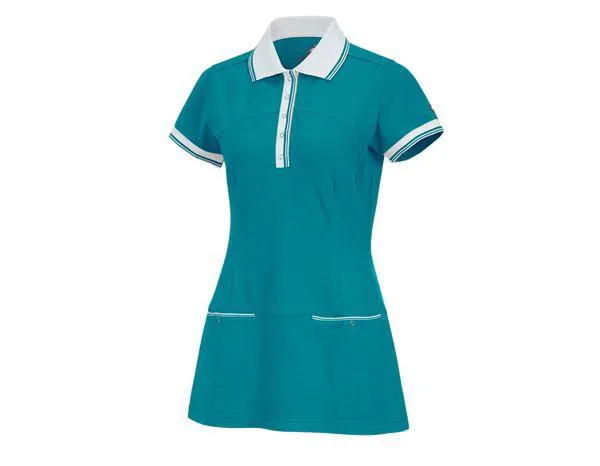
workwear waiter women Dress branded logo
custom-logo printed workwear “waiter / waitress” dresses (women): factory-prices in Turkey and globally, fabric options, printing/branding techniques,
- Basic Polo Dress — lightweight, sporty dress, good reference for performance fabric.
- Short-Sleeve Jersey Dress — jersey knit, shows how a simple silhouette works.
- Logo Tee Dress — casual tee-dress style, useful if work dress is more relaxed.
2) Factory / Wholesale Prices
Here are realistic factory-level price bands, based on uniform-dress manufacturers and workwear suppliers:
- According to Made-in-Turkey, waitress / hotel work dresses (poly / cotton blend) are priced around US$10.35 – US$12.52 for MOQs ~100 pcs. Made-in-Turkey
- Another Turkish factory offers “Dress for Waiter / Waitress” at US$12.52 / piece for a custom design. Made-in-Turkey
- For more “professional / server dress with half-high collar,” FOB price from a Chinese factory is US$8.99 for 100–999 sets. Made-in-Turkey
- On the higher end / more formal uniforms, some waiter-uniform-dress models (hotel / premium) go up to US$28+ for quality or custom cuts. Made-in-Turkey
- For Turkish production: local workwear suppliers / uniform makers don’t always list a “dress” explicitly — many specialize in aprons or tunic tops. For instance, Onlukcum (İş Elbisesi / önlük üreticisi) lists very low-cost aprons and tops, but not tailored waiter-dresses on their web-catalog. Made-in-Turkey
- Because uniform-dress is a more niche product in Turkey, expect Turkish factory pricing (for custom dress + logo) to be somewhat higher per piece (especially for smaller batches).
3) Fabric Options & Tradeoffs for Waiter / Work Dresses
When you design a work dress for restaurant / hospitality, fabric choice is critical: durability, breathability, ease of cleaning, how well it handles branding all matter.
Here are recommended fabric options + pros / trade-offs:
| Fabric Type | Composition | Pros for Waiter Dress | Cons / Considerations |
|---|---|---|---|
| Poly-Cotton Twill / Blend | 65% polyester / 35% cotton or similar | Durable, wrinkle-resistant, easy to wash, less shrinkage | Slightly less breathable than pure cotton; print adhesion is good for many techniques |
| 100% Cotton Poplin / Twill | Pure cotton | Very breathable, natural feel, good for embroidery or DTG | Wrinkles more, may shrink if not pre-shrunk, heavier maintenance |
| Polyester (100%) | Synthetic | Very durable, quick-drying, resists stains, ideal for uniforms | Less breathable, may feel less “natural”, requires the right print method for synthetic |
| Stretch Blend (Cotton / Poly + Elastane) | Cotton + elastane or poly + spandex | Comfortable, flexible, allows movement | Embroidery / thick prints may need stabilizer, stretchy fabric can distort printed logos |
| Microfiber / Performance Polyester | Lightweight synthetic | Great for high-activity roles, very breathable, dries quickly | Needs careful choice of print (sublimation or transfer better than heavy plastisol) |
4) Printing / Logo Techniques: What to Use & When
Here are the main decoration techniques that work well on work dresses + how they compare + cost-drivers:
- Embroidery
- Great for: chest logos, staff name tags, small back detail.
- Pros: very durable, professional look, excellent wash resistance.
- Considerations: on thin dress fabric, you may need backing; stitch count affects cost heavily.
- Screen Printing
- Good for: bold logos, restaurant brand names, text or small graphics on front or back.
- Pros: cost-efficient at scale, high opacity possible, very durable.
- Considerations: setup per color; on synthetic (poly) fabric, need correct ink; on delicate or drapey fabric, thick ink may stiffen.
- Heat Transfer / Vinyl / DTF (Direct-to-Film)
- Use for: multi-color logos, gradients, photographic or very complex designs.
- Pros: flexible design, lower setup than screens for many colors, works on many fabrics.
- Considerations: “feel” of transfer depends on film; quality of heat press and adhesive is important; wash durability test needed.
- Sublimation
- Best for: 100% polyester dresses (or poly blend) where you want full-panel patterns, prints that feel “in” the fabric.
- Pros: no added “ink hand”, very breathable, long-lasting color.
- Considerations: only works on synthetic or treated fabrics; requires pre-treatment / correct base color; can be more costly per meter of fabric.
- Woven Labels / Patches / Appliqué
- Use: brand tags, name tags, decorative brand patches sewn on dress.
- Pros: clean, premium look; can be replaced / repaired.
- Considerations: adds sewing steps; cost of woven patch + labor.
- Reflective Transfer (if needed)
- Less common on waiter dresses, but if staff works in low-light or needs visibility, reflective prints can be used.
- Need to ensure heat-application is correct and that reflective patch is durable.
5) Cost-Drivers & Production Considerations
When you negotiate with factories / uniform makers for custom waiter dresses, these are the main levers and risk factors:
- Fabric Composition & Weight: Polyester costs, cotton costs, stretch blends, etc.
- Dress Design Complexity: How many seams, darts, pleats, pockets — simple dresses cost less.
- Logo Size, Complexity & Placement: More colors, larger graphics, more placement points = higher decoration cost.
- Order Quantity (MOQ): The bigger your order, the more the factory can absorb setup.
- Sample / Pre-Production: Ask for a prototype dress before full production.
- Quality Control: Specify stitching tolerances, seam strength, how the logo should look, wash-testing for prints.
- Packaging: Uniform dresses often require specific packing (hanger / folded / poly bag) for delivery.
6) MOQ & Lead Times (Based on Uniform Dress Factories)
- Many Chinese uniform dress suppliers have MOQs in the 100+ piece range for custom designs. Made-in-Turkey
- Sample cost for designs can vary: for example, one uniform factory (W2271 model) says sample cost is US$30–100 depending on design, and sample lead time is 3–5 days. Made-in-Turkey
- For mass production, lead time is often 2–5 weeks depending on complexity, fabric sourcing, and order size.
7) Suggested RFQ Checklist (What to Ask Factories)
When you reach out to uniform manufacturers / factories with your “waiter dress + logo” spec, include:
- Product spec: style of dress (silhouette, collar, sleeves, length) + tech sketch or reference photo.
- Fabric: composition (cotton / poly / blend), weight (GSM), any stretch, supplier swatch or catalog code.
- Sizes: size range and quantity per size (S, M, L, XL, etc.).
- Colour: main body color(s), trim color, Pantone if needed.
- Logo: artwork (vector .ai/.eps), placement, size in cm, number of logo locations.
- Decoration: what method(s) you prefer (embroidery, screen, DTF, sublimation, label) — ask factory to quote by method.
- Trim / finishing: buttons, zippers, darts, pockets, lining (if any).
- Sample: request sample cost, whether sample is refundable, lead time, and if they can show pre-production sample.
- Order quantities: ask for pricing tiers (e.g. 100 pcs, 200 pcs, 500 pcs).
- Packaging: how each dress will be packed (folded, hanger, poly bag) + labeling / hangtags.
- Quality: ask for inspection options, tolerance on seams, details on how logos should be inspected.
- Payment / Shipping: EXW vs FOB, deposit, balance payment, lead time, shipping terms.
8) Assessment + Recommendations
- Best sourcing strategy: For waiter dresses, Chinese OEM factories seem very competitive (prices as low as ~$10–13 for many designs). Use them if MOQ is acceptable.
- For Turkish production: Use local uniform makers if you need smaller batches, faster turnaround, or want “made in Turkey” branding — but expect per-piece cost to be higher than Chinese FOB.
- Fabric recommendation: Poly-cotton blend is probably your most practical for workwear “waiter dress” — it balances cost, durability, appearance, and printability.
- Logo method: If the logo is simple and fewer colours, screen printing + embroidery is ideal. For more complex designs or colorful logos, DTF is a very flexible choice.
Expanded Price Ranges
Factory Cost Factors
Price Band Estimates:
| Region | More Detailed Cost Ranges (Factory / OEM) |
|---|---|
| Turkey | According to Turkish workwear manufacturers, uniform production (incl. custom design, embroidery) can be significant; Turkey-based workwear factories accept complex workwear orders. Tiger textile turkey Manufacturer Fabrics from Turkish uniform fabric suppliers: work-uniform fabric FOB ~ €2 – €10 / meter for different quality / blend. Tiger textile Thus, a custom dress in Turkey (uniform, tailored) likely €12–€30+ / piece in small or medium runs, depending on design + fabric + logo. |
| Turkey / Global OEM | Uniform-restaurant dress prices (poly / cotton blend) seen in China: US$10.35 – $12.52 / piece for MOQ ~100. Tiger textile For simpler designs or lighter fabric: lower; for more complex / premium uniforms: higher. Workwear manufacturers in Turkey caution that “prints, embroideries, custom make” may raise cost significantly. Clothing Manufacturer Turkey |
Expanded Fabric Options for Work / Waiter Dresses
- Poly-Viscose / Poly-Viskon
- Blend commonly used in corporate / hospitality uniforms.
- Pros: smooth drape, color retention, wrinkle resistant.
- Cons: slightly synthetic feel; care instructions matter.
- High-Quality Polyester
- 100% polyester or “performance poly”.
- Pros: very durable, quick-dry, stain resistance, good for heavy-use scenarios.
- Cons: heat sensitivity (printing / embroidery), breathability.
- Stretch Blends (Poly / Cotton + Elastane)
- Adds flexibility to the dress, more comfort for movement.
- Pros: better fit, comfortable, more dynamic silhouette.
- Cons: stretch affects how embroidery or heavy print sits; needs stabilizer.
- Cotton Poplin / Shirting Fabric
- Light-medium weight cotton.
- Pros: very breathable, natural feel, well suited for embroidery or fine print.
- Cons: wrinkles; may require pre-shrinking; not as durable under high washing as synthetic.
- Gabardine / Twill Weave
- Heavier cotton or poly gabardine.
- Pros: structured, professional look, holds shape.
- Cons: heavier, may cost more, less “flowy”.
- Poly-Cotton Twill (Uniform Blend)
- Classic uniform fabric.
- Pros: balanced durability, cost, maintenance; works well with both embroidery and print.
- Cons: synthetic content may affect some inks / transfers.
Advanced Printing / Decoration Techniques
- Digital Textile Printing (Custom Panels)
- Use: print full fabric panels (before cutting) so logos/patterns are part of fabric.
- Pros: very clean, all-over design, no “print feel” on surface.
- Cons: cost per meter; requires alignment in cutting; only useful if design is repeated.
- High-Stretch Heat Transfers
- Use: for stretch-blend fabrics — special stretchable PU or DTF films.
- Pros: accommodates fabric stretch; logo remains flexible.
- Cons: longer press times; quality of film / adhesive critical for wash durability.
- Reflective / Safety Transfers
- Use case: if waitress dress also needs visibility (e.g., outdoor events, catering at night).
- Technical note: require correct temperature/time and proper reflective material to endure regular washing.
- Metallic / Specialty Inks for Screen Printing
- Use: small luxury or brand-detail logos (e.g., gold metallic hotel logo).
- Pros: premium visual effect.
- Cons: can crack if the dress has tight curves; need flexible ink.
- Laser Cut Appliqué or Leather / PU Branding
- Use: logo made from a separate material (fabric, faux leather) and sewn on.
- Pros: 3D effect, very premium feel.
- Cons: extra cost for patch + sewing.
- Inkjet / Reactive Printing on Natural Fabrics
- Use: for cotton or viscose where you want full-color, soft prints.
- Pros: detailed, soft-hand feel.
- Cons: colorfastness and wash durability should be tested.
Key Cost Drivers (New / Extra Focus)
- Fabric blend vs pure fabric: blend fabrics (poly-viscose, stretch) often cost more than basic poly or cotton.
- Complex design details: darts, pleats, fitted waist, zipper or pockets all raise cost.
- Decoration method: embroidery is more expensive than a simple print; specialty transfers add cost.
- Wash durability: uniform dresses are often washed frequently — require high-quality inks or stable embroidery, which cost more.
- Sampling: for fully custom dresses with prints + patches, you should budget for sample cost + pre-production sample.
- MOQ for specific fabric + decoration combos: smaller MOQs may force you to take more expensive setup.
Example Products to Reference (for Style + Fabric)
- Pleated Shirt Dress: A shirt-dress style with a pleated skirt — good reference for tailored uniform dresses.
- Classic Uniform Dress: Simple, classic work uniform dress design — likely easy to decorate / embroider.
- Poly Performance Polo Dress: Synthetic performance fabric — great for uniforms that need durability and stain-resistance.
Recommendations
- Use different fabric options (poly-viscose, stretch blends, gabardine) to get the right balance of cost, durability, and comfort.
- Ask factories for quotes for 3–4 decoration methods (embroidery, transfer, applique) to compare cost vs look vs durability.
- Include wash durability tests in your spec (especially for prints / transfers).
- Negotiate sample cost and insist on a pre-production sample so you can check quality, color, fit, and how the logo looks on the final fabric.